

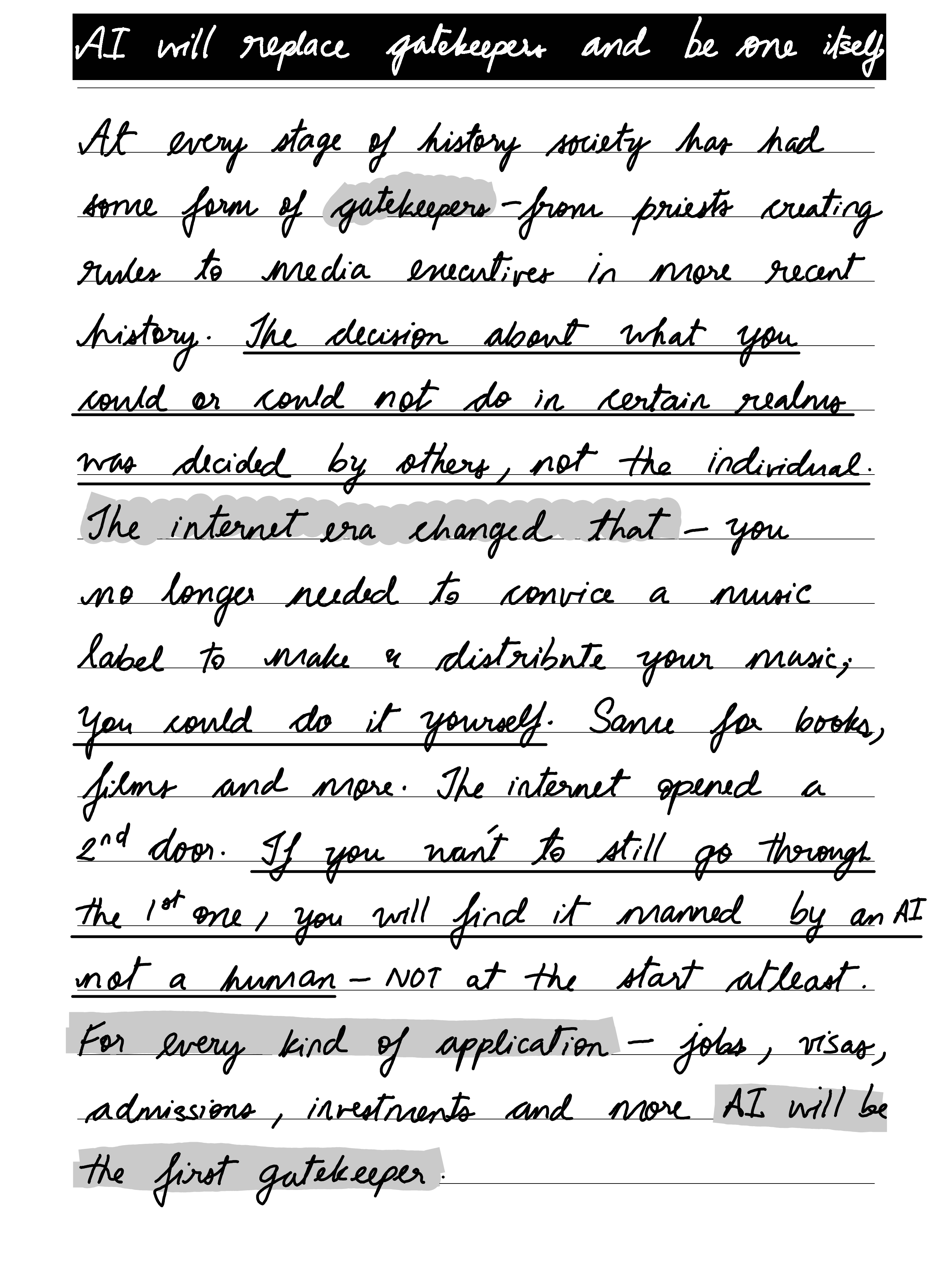
The studio executive decided if your story would see the light of day.
The editor decided if your words reached readers.
The record executive decided if your music existed at all.
For most of history, you needed permission to participate.
Then came the internet.
You could upload your music without a label. Publish your book without a publisher. Broadcast your thoughts without a network. The side door swung open. For twenty years, you could walk through.
That door now has a (new) lock.
When you apply for a job, a resume-scanning AI decides if a human ever sees your name. When you seek a visa, an algorithm scores your application before a consular officer glances at it. When you submit a paper, a detection system judges your originality. When you request funding, a model estimates your likelihood of success.
You used to need a human’s blessing. Now you need a machine’s.
Gatekeepers have always existed. But AI gates faster, cheaper, and at scale. It never sleeps. It holds no sympathy. It cannot be charmed, persuaded, or convinced with a story.
The human gatekeeper could be circumvented. The side door worked because a person might look up from their stack, see something in you, and open the latch. AI has no peripheral vision (yet). It sees only what it was trained to see.
There is freedom in this. The old gatekeepers were biased, slow, and inconsistent. AI offers speed and, ideally, fairness. If you match the criteria, you pass. No politics. No favoritism.
But there is also loss.
The side door that the internet opened is now being rebuilt with an algorithmic lock. Those who learn to pick it will pass. Those who don’t will knock on a door that doesn’t answer.
The question is not whether you can get in.
The question is whether you can write for the machine that decides if you deserve the chance to be seen by a human*.
*Unless you have a direct relationship, that isn’t filtered by the algorithm, like Substack